Saturday, January 10, 2026

A seemingly endless plane ride

We left MCI at about 2:00 PM on January 8th, headed to New Delhi via DFW and Doha, Qatar.  We finally arrived at our lovely hotel, the Suryaa, after a 27 hour journey, at about 5:00 AM on the 10th with a little help from the International Date Line. We’re sleeping-in this morning to try and beat our jet lag, before starting our program with dinner at 6:00 PM this evening. 

Having arrived well after dark last night, we haven’t really seen anything of New Delhi yet except the crowded immigration and customs facilities at the airport, so photos of India will have to wait. In the meantime, however, we did take a few shots in the remarkably luxe (and HUGE) Doha airport crammed with multiple locations of every high-end retailer in the world. We noticed that they didn’t install nearly enough seating for the number of people transiting the airport, presumably hoping to keep everyone wandering through the shops. 


Wednesday, January 7, 2026

We leave tomorrow morning on this trip. We'll be posting on this same Blogger site we used on our trip to Vietnam some years ago. We'll be happy to bore you to death with stories when we return!


Saturday, October 25, 2014

Some random observations and last reflections on a trip (with apologies to Bernard Fall)


  1. Travel Vietnam is a world class travel agency.  We'd recommend them to anyone planning a trip to Southeast Asia. Every aspect of the trip, (except the visa SNAFU our own mistake caused) went off without a hitch. The guides were friendly and knowlegeable and spoke decent or better English, the drivers were skillful and patient in horrendous traffic, the hotels were wonderful and the restaurants they chose were uniformly great.
  2. A good guide is worth the modest cost of his/her service. We never would have seen as much or understood what we were seeing as well had it not been for our wonderful guides.  Tran, our Saigon and Delta guide was a true force of nature and was more determined than I was that I should see the location of the training center where I was stationed when I first arrived in Vietnam.  Had it not been for her persistence, we would have missed out on a wonderful visit with the "clam police" in Ba Tri.
  3. Having a driver pick you up at the station, get you to your hotel, take you to your tour start point in the morning, wait while you take photos and negotiate the horrendous city traffic, while you sit in the back seat, is a great way to travel.
  4. Traveling by train in Vietnam is NOT like riding on the Orient Express. It may beat riding in the back of a truck with the livestock, but not by much.
  5. We liked the countryside and the small cities on this trip a great deal better than the big cities (Hanoi, HCM City and Phnom Penh). The pace is not nearly so frenetic and the people seem genuinely pleased to see visitors. Folks in the big cities (apart from some of the market shopkeepers and tuk-tuk drivers) are polite, but in a big-city, preoccupied sort of way. By contrast, the Vietnamese and Cambodian people in the smaller communities are invariably friendly, curious and welcoming.
  6. The Vietnamese and Cambodian children are beautiful, seem happy and are eager to practice their elementary school English.  Kathy and I agree that the Vietnamese women are among the most beautiful in the world.  Kathy thinks the Vietnamese men look too young.  I don't know whether to be flattered or offended.
  7. The food, especially in Vietnam, is fabulous, healthy and cheap.  We'd all be skinny if we ate their diet of lots of vegetables, a liitle meat and very little fat.
Reflections

When I left the U.S. for Vietnam in October, 1972, I was convinced that it was long past time for the U.S. to be out of that war. Nothing I saw in my year there led me to conclude I was wrong. The South's collapse in 1975 was saddening but not surprising to me, and, In my  judgment, no amount of additional bombing or arms aid to Saigon would have changed the eventual outcome.

Coming back after 40+ years only reinforced my belief that our long involvement in Vietnam was a tragedy - for us, but more so for the Vietnamese. Almost 60,000 Americans lost their lives, but a million or more Vietnamese died, many more were maimed, the whole country was impoverished, and only now does it seem that the full potential of an industrious, intelligent people is being realized.

Vietnam today seems very much like the place American politicians said we were trying to help build back then.  The government is communist and only one party is permitted, but the people seem to be thriving in a market economy, where state-owned enterprises are competing with private businesses. The standard of sanitation is infinitely better now, everybody seems to have a motor bike, at least in the cities, and every square inch of land appears to be devoted to intensive agriculture, including areas that were thoroughly defoliated and churned up by bombing when I was there, Religious practice among Buddhists, Catholics and Cao Dais appears to be thriving, with new churches, temples and pagodas everywhere. Despite the government's control of the media, at least some of the people who have the most frequent contact with foreigners are candid and critical of their government's shortcomings, especially its cronyism and corruption.

I don't intend to minimize the suffering endured by our allies and their families, many of whom spent years in "reeducation camps" or worse. Everybody in Vietnam seems to have a grim story to tell about their family's experiences during the war.  One of our guides' father went missing in action in Quang Tri province in 1968.  Her mother never recovered from her grief.  Another's father was reported by his comrades to have been killed on the Ho Chi Minh Trail, but returned home unannounced and ill with malaria shortly after his family had been told of his death.  Still another's grandmother escaped to the US and persuaded her daughter to try to join her. After three unsuccessful tries, daughter and granddaughter decided that fate intended them to stay in Vietnam.  The granddaughter even spent a day in jail once while on holiday, when the police assumed she and her aunt were trying to escape because they had packages of food and clothing with them for their holiday trip. Mr. Tranh, the ebullient historian, antique collector and government consultant we met, spent three years in a camp being "rehabilitated."

Nevertheless, it is difficult not to think that if we knew in 1956-1963 what we now know the eventual outcome for Vietnam would be - a country friendly to the U.S., wary of China, at peace with her neighbors, and relentlessly focussed on developing her economy, we would have welcomed the prospect, avoided the suffering, loss of life and devastation caused by the war and advanced the date when Vietnam would achieve its present state by 25 or 30 years.

Likewise in Cambodia. I don't know a great deal about the Cambodian civil war, but it certainly seems that the U.S. helped bring it on by undercutting a popular, but "neutralist" king who would not join our fight against the VC and North Vietnamese, and aiding his usurper who was willing to fight the Vietnamese. North Vietnam's concurrent support for the Khmer Rouge to help protect its Cambodian bases and supply lines helped build the maniacal regime that took power in Cambodia in 1975.  It is not difficult to believe that the spread of the war into Cambodia helped to create a powerful Khmer Rouge army and that if the war had not metastasized, Cambodia might have been spared the catastrophe that accompanied the Khmer Rouge's 1975 takeover. Anyway, I have no doubt now that our involvement in that war too was a mistake.  

I wasn't too happy to come to Vietnam the first time, but I am beyond glad to have come back to Southeast Asia on this trip.  I'm also very happy to be heading home.

Goodbye.

Awestruck and overwhelmed!


Words are utterly insufficient to convey the overwhelming scope, magnificence and mystery of the Angkor temples.  At a time when there were maybe 50,000-100,000 people living in Paris, the largest city in Europe, the Khmer empire had built a city 20 miles square, with as many as 1,000,000 inhabitants. It is truly overwhelming to try to take in.


The temples are stupendous.  Bigger by far than anything I've seen in Mexico or Europe. Some structures have been reclaimed from the jungles, but others are still wrapped in giant tree roots.  The temple at Ta Prohm was used as a location for the Tomb Raider movie to take advantage of the great images of elephant trunk-like roots enveloping the buildings.


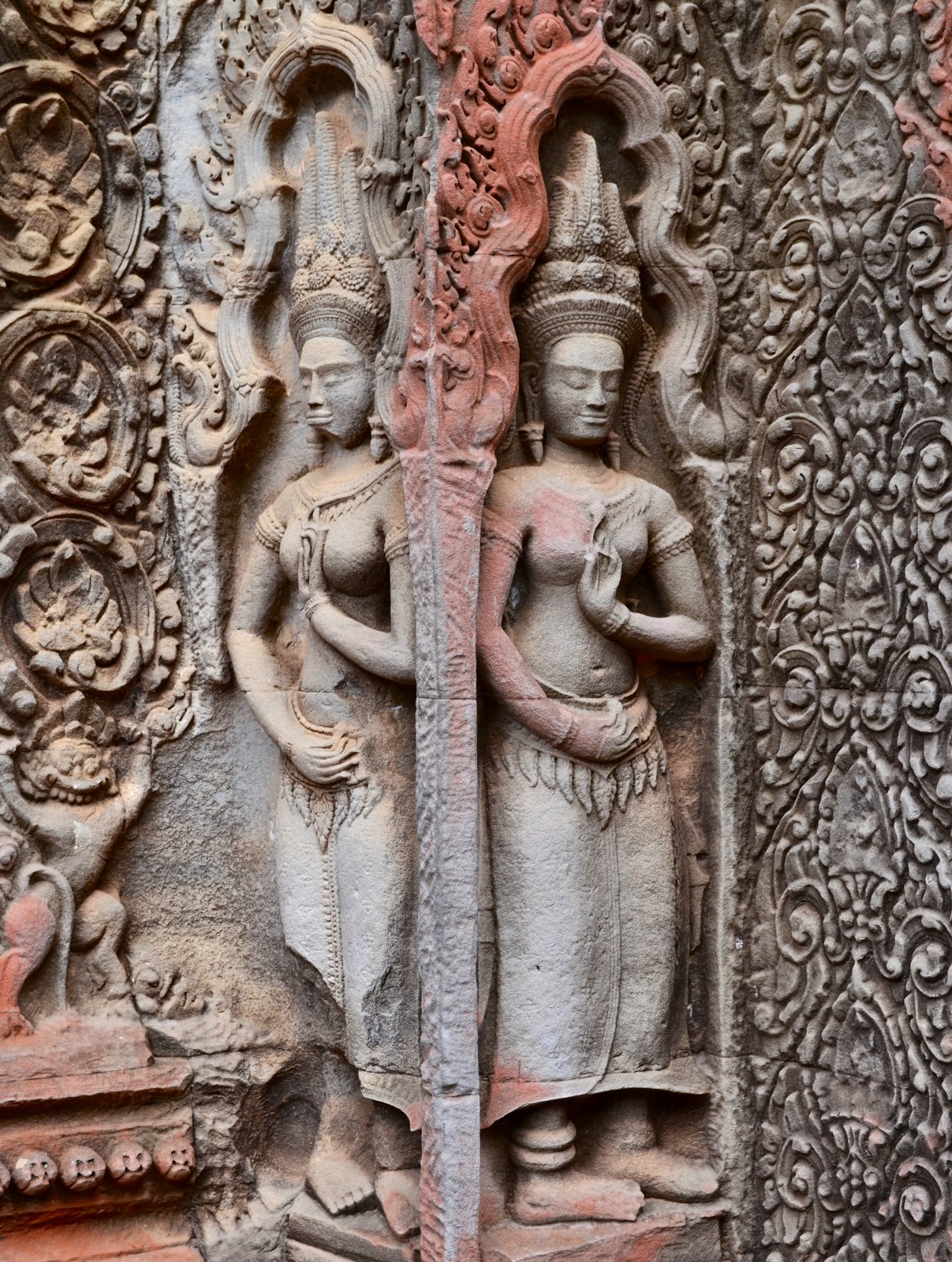
The decorations, including statues, carvings, and bas-reliefs, are every bit as impressive as the buildings themselves.  Some of the ornamentation has been badly treated by erosion, the collapse of many of the buildings, and the fighting that took place here when the VC and Khmer Rouge controlled the are in the '70s' (there's even some VC graffiti from 1972 in one building), but other stone carvings look like they were completed last month.


We had another great guide, but trying to absorb the enormity of the Khmer's achievement in a couple of days, is like trying to learn trigonometry in a week.  The first order of business when we get back to Lawrence will be to get a good book on the Khmers and try to reflect on what we experienced.


Siem Reap, the provincial city which serves as a gateway to Angkor, is a lively town, full of resorts, restaurants and bars and a busy night tourist market.  We had dinner downtown last night and it was like being in Cancun or Cabo San Lucas - lots of young people from all over the world having lots of fun.


Hotel rooms are inexpensive as is food and drink.  That, coupled with the incomparable ruins, makes for a pretty great  vacation spot.  Unfortunately, it is now so popular, that up to 3,000,000 tourists a year are visiting and putting a huge strain on the monuments and the environment.

We'll spend tomorrow visiting the National Museum branch in Siem Reap and then chill until our 11:30 PM flight to Seoul. Home on Sunday.  It will be good to be back!

I'll try to post some final reflections tomorrow before we leave.

Thursday, October 23, 2014

An emotional roller coaster in Phnom Penh

Up Wednesday at 5:30 to clean up, talk to Rebecca on FaceTime, have breakfast and meet our guide at 7:50.  Our first stop was at S-21, the former school the Khmer Rouge used as one of their prison, torture, and interrogation centers. 


The museum is chilling. The setting is so ordinary. Apart from the barbed wire covering the porticos, the buildings look like any other school set down in an urban neighborhood. 


The jailers, like the Nazis, photographed each of their victims (20,000 at this center), which included intellectuals, merchants, monks, soldiers from the Lon Nol regime, foreigners, and towards the end, even senior Khmer Rouge cadres who had fallen out with the leadership. 

A few individuals survived the prison and later wrote about and painted vivid scenes of the torture and cruelty they observed. 


Kathy and I had our photo taken with one of the survivors and purchased a copy of his book.


The killing fields themselves are disturbing in a different way.  The setting, in an abandoned Chinese graveyard close to a lake, is almost peaceful.  The mass graves where the murdered victims from S-21 were buried are shallow overgrown depressions in the grass. The remains of the victims, however, are a constant reminder of the not so long ago horrors that occurred there. In the rainy season (which is just ending now) bones, clothing fragments and teeth work their way to the surface.  I haven't travelled to Auschwitz, but I suspect the feeling surrounding the places is similar.  The scale of the savagery seems comparable - of a wartime Cambodian population of 8 million, around 2 million died in the purges, forced labor and combat that occurred in the late '70's.


The afternoon tour served as a partial antidote to the grim morning stops.  After shopping for 45 minutes at the "Russian Market," we had a great lunch in a small boutique hotel/restaurant before touring the city's founding namesake's temple 
and  the National Palace and adjacent Silver Pagoda.  The buildings, especially the pagoda, are fabulously decorated and beautiful set off against the afternoon skies.


Our flight to Siem Reap left at 6:00 PM, so we had to wrap up the sightseeing early and get to the airport.  After a short and uneventful flight we landed in Siem Reap, the final stop on our tour.  Our new guide met us at the airport and drove us to another beautiful hotel.  Thursday, we start our tour through the Angkor sites early, so we'll turn in now and write more tomorrow.

Upriver to Cambodia

We got up early to catch the speedboat from Chau Doc to Phnom Penh. A couple of pedicabs were at the hotel at 6:30 to shuttle us to the dock.


The trip to the river took us past an school complex where parents were having breakfast in street corner restaurants with their kids before sending them off to join their classes.

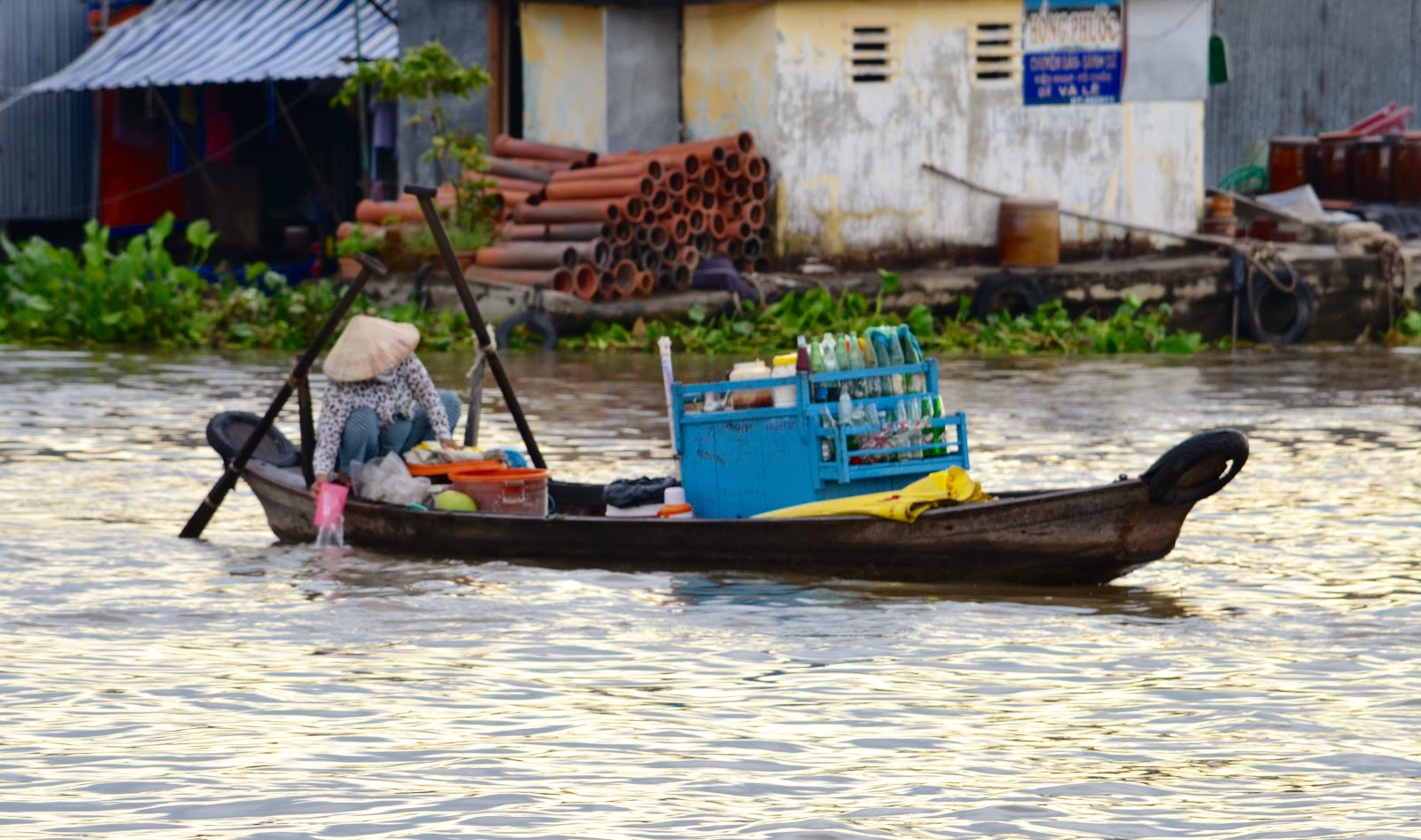
I shot a ton of pictures of activity on the river in the early morning while we waited for the boat.


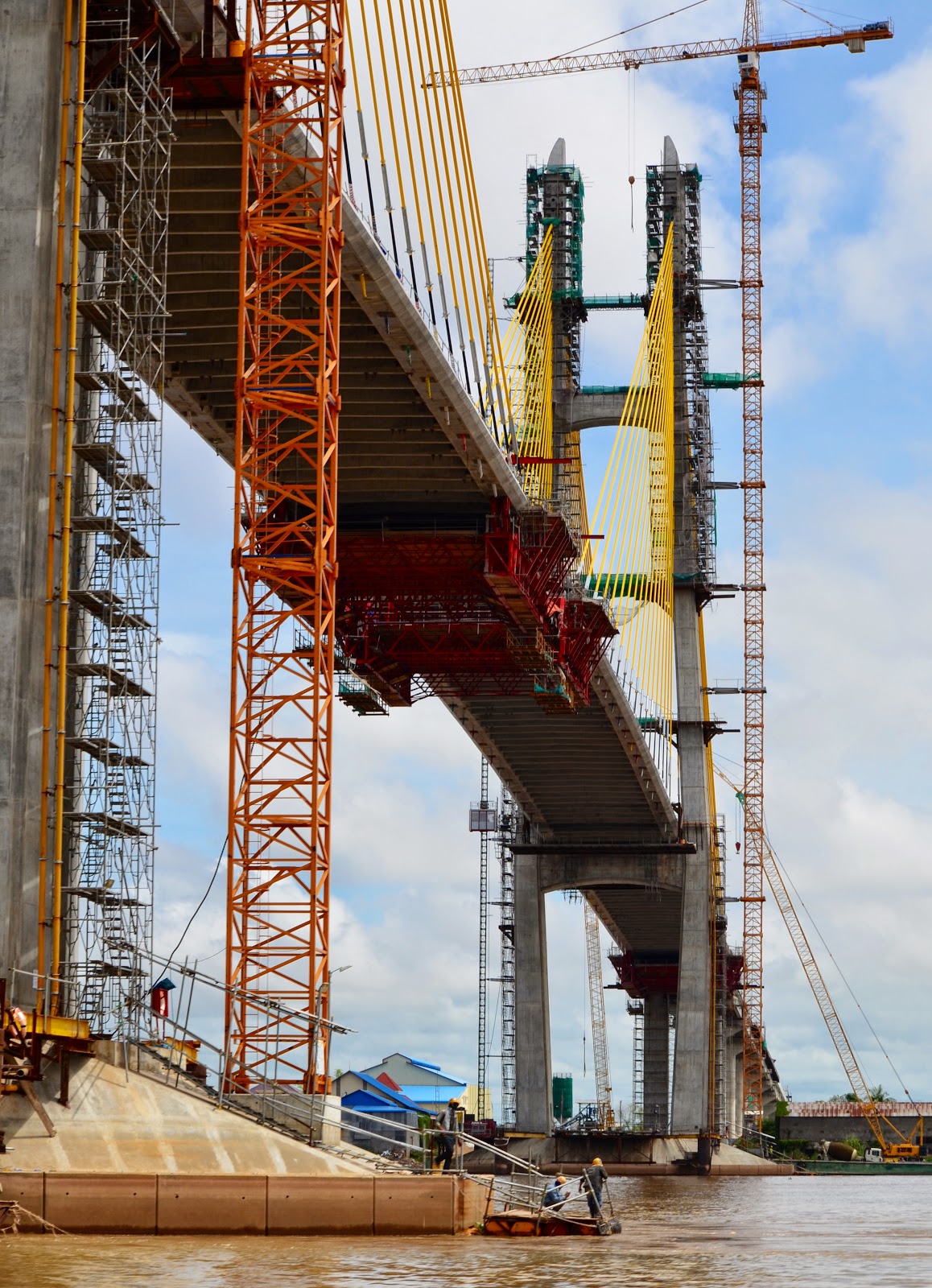
Once we got under way, we cruised up the Mekong for about an hour before stopping first at Vietnamese border control and then, a mile or so upriver, at the Cambodian border post to obtain visas.  After about an hour and a too early in the morning Cambodia beer, we resumed our trek to Phnom Penh.  We passed under a huge new suspension bridge under construction about 20 miles south of the city.


Once we landed, a new guide met us to escort us to another in a string of memorable hotels - the White Mansion. Our room on the top floor featured a terrace with a fabulous view of the thunderheads building over the city.


We decided to walk to the National Museum to catch the exhibitions before it closed.  The walk was a constant barrage of propositions from tuk-tuk drivers offering tours.  The museum's collections of statuary from Angkor and other Cambodian historical sites is wonderful.  Kathy and I both wish we knew more about Buddhism and Brahmanism, the religions melded by the Khmers and celebrated in the Ankorian temples.


We walked by the National Palace and Silver Pagoda, which we will tour tomorrow.  The buildings are stunning from the outside.  


After we left the Palace environs, we ran another gauntlet of aggressive tour guides and tuk-tuk entrepreneurs on the way back to the hotel, getting semi-soaked by the rain in the process.  We stopped in a wine shop to buy a couple of bottles of French wine.  As we left the store, we noticed another well stocked wine shop across the street.  That was two more well stocked shops that we saw in three weeks in Vietnam.  From the large number of French and Italian restaurants in the city, there seems to be a lot more European cultural influence in Phnom Penh than in Vietnam - at least in the cuisine. After a beer on our rooftop terrace, we headed out to dinner in our own tuk-tuk.  The driver took us to an Italian place recommended by the proprietor of our hotel's restaurant.  Our driver insisted he would come back to pick us up when we were done.  I don't know why I was surprised when he actually did.  We had trouble settling our bill at the restaurant - first, because while the US dollar is the de facto Cambodian currency, they wouldn't take an old $100 bill (apparently because Phnom Penh is a center for passing North Korean counterfeit US Currency) and second, because one of my credit cards wouldn't work and they didn't take Amex.  Kathy had to treat me.

I have mixed impressions of Phnom Penh.  The hotel and wait staff are charming, the children lovely and friendly and many of the public buildings are impressive.  The aggressive hucksters are a turn off and the city has a reputation for street crime by thieves on motorbikes like Saigon did in the '70's.  In fact it reminded me of Saigon in 1972 in other ways, too including the location of some high end homes, hotels and businesses in otherwise shabby neighborhoods.

We're steeling ourselves for a tough day tomorrow, including a trip to the genocide museum and the killing fields. Got to turn in early.  More tomorrow.